
Ways to Lose Body Fat Besides Cardio
August 9, 2026

Welcome to the Blog
Hey, I'm Laurie
Consider me your go-to gal for all things fitness, nutrition, and healthy lifestyle.
It’s no news that weight loss / fat loss isn’t my most favorite topic to write about. Especially right now, when it feels a bit like the ’90s again and the message everywhere is shrink, shrink, shrink.
But everyone deserves to be healthy, feel good in their skin, and not spend their life at war with their body. And it doesn’t do anyone any favors if I’m gatekeeping what I know.
So here’s a detailed guide to fat loss, from someone with a formal education in nutrition and 18+ years of coaching experience.
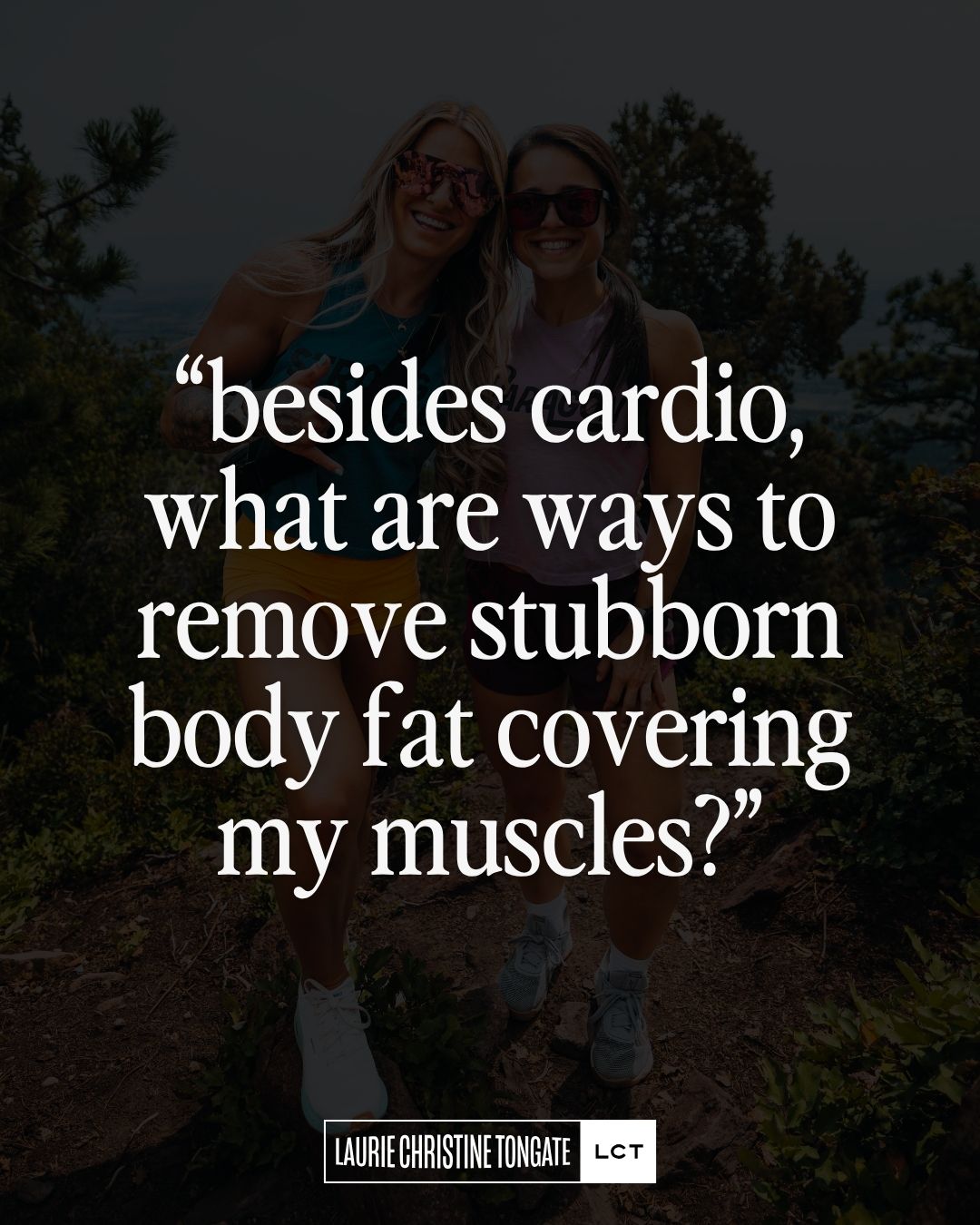
The question that prompted this: “Besides doing more cardio, what are other ways to remove stubborn body fat covering my muscles?”
I love this question, because “doing more cardio” might actually be at the bottom of my list for someone wanting to begin their journey toward fat loss (:
First, a caveat
Data clearly shows most Americans aren’t moving their body enough. And the majority of people also don’t meet basic weekly guidelines for aerobic exercise.
Whether you’re maintaining where you’re currently at or if chasing weight loss, hopefully you’re lifting AND doing some cardio each week, as both are equally important for health and longevity.
If you’re not doing that yet, then yes – start there and make that change now.
Can you lift 2-3x/week for 30-60 minutes? Can you get in 1-2 cardio sessions per week?
You may have less muscle than you think
Most people probably don’t have nearly as much muscle as they might think they have.
It’s common to see thinking like “I just need to lose x pounds” and you’ll find a six-pack and a super defined physique. And maybe. Or maybe not.
The obstacle between A and B may actually be that you need to get stronger and gain way more muscle than you currently have (and not necessarily that you need to drop a ton of weight).
Or maybe in order to improve your physique, you need to lose body fat AND gain more muscle.
Or maybe you do have a good amount of muscle and really do just need to lean out a little.
Obviously I’m writing this knowing absolutely nothing about the person reading it. But hopefully I’m doing a decent job of highlighting the nuance here (:
Building muscle takes longer than you want it to
In my extensive coaching experience, those with really muscular, athletic, impressive physiques are often people who have been lifting, training hard, and living an active lifestyle for 5-10+ years, if not way longer.
And don’t get me wrong – it’s definitely possible to build an impressive physique in a shorter time frame.
But building muscle takes:
- time
- a lotttt of patience
- and if you’re beyond the “newbie gains” phase and have already been lifting for a few years, also typically takes a fair bit of intentionality with both your nutrition and training
Meaning: just because you’ve been pretty active doesn’t necessarily mean you have a lot of muscle. Especially if you’ve been doing tons of cardio or activities that don’t involve strength training.
Monitoring how much you’re eating is king
When it comes to successful and predictable weight loss or fat loss, monitoring how much you’re eating is king.
People love to trash macro tracking and hate on the idea of weighing or measuring food. But here’s the thing: you’re recording and collecting data over time. It’s manipulatable.
If you can enter your food and meals into a tracking app with fairly minimal effort, you have a real-life science experiment you can observe, manipulate, and change over time.
The most common mistake I see is someone going from 0 to 100 and suddenly doing hours and hours of exercise per day. It’s not ideal.
We still don’t have a reliable way to estimate how many calories we burn during most exercise. And you’re likely just going to be battling excessive soreness and extreme hunger swings, which probably isn’t sustainable or enjoyable over time.
Sure, you may see weight loss at first. But what are you going to do when that weight loss stops? Go from 2 hours of exercise to 3 each day? Quit working, stop being social, and give up all your free time?
If you have a fairly consistent exercise routine and already exercise 3-5x/week, most of your energy should probably be redirected toward your nutrition and making changes to what and how much you’re eating. Because you have to be in a deficit below your maintenance threshold to lose weight.
In my opinion, it’s way easier to establish a consistent workout routine and then monitor and manipulate your food over time, versus blindly throwing workout paint at the wall and praying the scale changes.
Fat loss can and SHOULD be predictable.
How to actually approach the deficit
The easiest way to go about this is to track your food in a macro tracking app. Then keep a spreadsheet so you can see what your protein, carb, fat, and calorie totals look like each day across each week.
Start with a small deficit – around 10% below maintenance. Wait 2-3 weeks. If nothing’s changing, shift to 15%. Wait another 2-3 weeks. Still nothing? Move to 20%, and so on. Some people may need to go as deep as ~25-30% below maintenance to see successful fat loss.
But please don’t jump to a huge deficit out of the gate. Slow and steady, for two reasons:
- What if you could see success at a smaller deficit and be less hungry along the way?
- As time goes on, you may have to lower calories more and more as you plateau anyway.
If you go scorched earth and start at a 25-30% deficit, you’ve left yourself nowhere to go.
Do macros matter?
Short answer: yes and no. When dieting, you don’t need to stress over hitting 2039434 specific macro goals each day.
Prioritize protein. Somewhere around 0.7-1.0 grams per pound of body weight or goal body weight is a reasonable target. At 150 lbs, that’s roughly 105-150 grams per day.
Prioritize staying under your calorie goal. Consistently eating above it may mean you’re not actually in a deficit.
Don’t stress over specific carb or fat targets. Carbs support workout performance and recovery, so prioritize those while staying under your calorie goal. But fats matter too – it can be common to see hormone or period problems when fat intake is consistently very low, so aim for a reasonable minimum and fill the rest of your calories with carbs.
These are general starting points, not individualized prescriptions. If you want numbers matched to your body, your training, and your medical history, work with a registered dietitian or nutrition coach.
Know your maintenance first
Not a clue what your maintenance calories are? Then that’s where you need to start.
You’re over here trying to do back tucks and full twists when you don’t know how to cartwheel.
I said this already, but achieving successful fat loss shouldn’t be a guessing game or a mystery. It can and should be fairly predictable.
And listen: I know we’re all impatient for the things we want. But your body isn’t Amazon Prime. The best coaching advice I can give is to buckle in, take your time, and build your foundation first.
Spend a few weeks or months tracking food, weighing yourself, and figuring out how many calories you can eat in a day and still maintain your weight.
Because if there’s one thing I can say with confidence after coaching for 18+ years: nutrition results that come quickly are often results that were unsustainable and don’t stay.
Lifting should be a constant
When it comes to fat loss, lifting several times a week would ideally be a priority.
Keep in mind that high-intensity exercise (CrossFit, OTF, F45, HYROX) or doing tons of heavy compound lifts can come with a high recovery cost and may leave you hungry. With the first, you’re smashing a lot of reps and training volume. With the second, you’re working multiple body parts at once and really taxing your body and central nervous system.
If those are your preferred ways to move your body, that’s fine — go get some. But know there may be ways to train right now that make it feel easier to get from A to B.
Having manageable hunger, consistently staying within your calorie deficit, and still being able to train and push fairly hard most of the time? That’s the fat loss sweet spot.
Why hypertrophy training is usually my suggestion
Rather than high-intensity exercise or tons of heavy strength training, hypertrophy training is typically our go-to suggestion for most people wanting fat loss.
And to be clear: all movement is good movement, and literally any form of movement CAN work during a fat loss phase.
But here’s an analogy. Could you train for a marathon by going to Orange Theory classes? Sure. Might you run a faster marathon and feel better if you spent most of your training doing zone 2, a weekly sprint, and a long run day? Probably.
So even if it’s temporary and not your favorite way to train, prioritizing hypertrophy training around 3-5x/week would be ideal.
“Hypertrophy” just means muscle building. Most physique competitors are hypertrophy training to gain muscle and lose fat. They’re not doing CrossFit, running half marathons, maxing out their deadlift, or doing HYROX sims. They’re training in a way that gives them a really effective return on their effort.
Two big reasons to prioritize it:
- We’re likely always going to lose some muscle alongside fat tissue when dieting. Performing challenging lifting sets each week should act as a buffer and help minimize that loss.
- If you’re newer to lifting, coming back from extended time off, or returning from injury or surgery, there’s a possibility you may even build muscle as you lose fat.
Steps and movement outside the gym
Another big one is your daily step count.
What you do in the gym for an hour a day is great. But what you’re doing during the other 23 hours is equally, if not more, important.
If you plan to be dieting, make it a pillar habit to prioritize a solid daily step count — somewhere around 8,000 steps is a reasonable target for most people.
And here’s the nice part: if you hit a plateau, increasing your daily steps is another lever. Unlike more lifting or more exercise, extra steps likely aren’t going to destroy your recovery or substantially shift your hunger. But they will burn more calories each day and could help keep things moving.
If you’d plateaued, you could drop calories slightly, or you could add an extra 10-15 minute walk each day. No right or wrong — just options.
Now, back to the cardio
Cardio is great. It improves your heart and overall health, helps you breathe less heavily when commuting, playing with your dog or kids, or walking up stairs. It can also greatly reduce your risk of heart disease, high cholesterol, high blood pressure, and diabetes.
But “cardio” is a very blanket term. Are we:
- sprinting, gasping for air, heart rate 185+?
- cruising at heart rate 125 on a bike or rower?
- running 10 miles up a mountain trail?
Much like “doing more exercise,” just doing more cardio is a vague and slippery slope. You may find yourself accidentally squashing your recovery, negatively influencing hunger, and making the whole thing way harder.
Like hypertrophy training, steady state cardio is usually my suggested cardio if you’re dieting. That means moving at a consistent pace and intensity for an extended period — call it 20-60 minutes — where your heart rate is slightly elevated, you’re working at a low to moderate intensity, and you could hold a conversation if needed.
Rowing, biking, the stair stepper, brisk walking on an incline treadmill. Like steps, it’s a fairly easy and reliable way to move your body without additional soreness or big changes to recovery.
A good starting rule of thumb: lifting at least 2-3x/week plus steady state cardio 1-2x/week.
Plateaued? Again, no need to go 0-100. If you’re doing two sessions, could you add a third? Or extend your current sessions by 10 or 15 minutes?
Should you really be dieting right now?
This is the section that ruins everyone’s day. But it’s important and worth exploring.
Much like money in a bank account, we can’t just keep swiping the card and spending endlessly without ever pausing to put money back in. Similarly, we can’t chronically under-eat and expect to keep driving the car on empty.
If you’ve been trying to diet without success, or you recently lost weight successfully, consider taking a break from dieting for a few months. Let your hormones, metabolism, mental health, and social life have a break from surviving on fewer calories.
“I’m doing everything right and not seeing progress”
I could write an entire article on this, but here are some of the big ones:
- Eating “clean” or eating keto or low carb does not guarantee you’re eating less or in a calorie deficit. It’s changing the types of food, not the amount.
- When portioning food, use a scale and measure in grams or ounces. Measuring cups and eyeballing are a surefire way to spin your wheels.
- Are you tracking the actual ingredients in your meals rather than generic entries? “4 oz 85/15 ground beef, 100g rice, 50g avocado” tells you far more than “burger and fries.”
- How much and how often are you drinking alcohol?
- How often are you dining out? It’s hard to guarantee accurate tracking there.
- How much sleep are you actually getting? If there’s ever a time to triple down on sleep, it’s when you’re dieting.
- Losing the war against hunger? How’s your fiber intake? Fiber supports better digestion and helps you feel fuller between meals.
- Nailing fiber and still hungry? Are you eating slowly, chewing your food, drinking plenty of water, getting enough protein, and eating lots of vegetables? Try filling half your plate with veggies at most meals.
- If you’re struggling with your weight and also dealing with symptoms like cold fingers, severe fatigue, hair loss, or infrequent bowel movements, consider seeing a doctor and checking your thyroid levels.
- If you’re hitting perimenopause or menopause, the two biggest culprits are usually alcohol and perhaps not being as active as you think you are.
A few more thoughts
Some of this isn’t about training or food at all.
Everything you had to do to look and feel great when you were younger, you probably have to do even better as you age. The sooner you accept this, the easier it all becomes.
The scale only tells part of the story. It can’t communicate whether you gained muscle, lost muscle, gained body fat, or lost body fat. It’s just a number. And a smaller number doesn’t guarantee you’ll look more defined. Your best physique may weigh more than you do now. Try to stay neutral and less attached to that silly little number between your toes.
Try not to compare yourself to bodies you see online. Lighting, angles, and 4K cameras make bodies look different than they might in real life. Audit your feed so you’re following more diverse body types and athletes from a variety of sports.
Rome wasn’t built in a day, and you won’t be either. Life ebbs and flows. You might achieve your best physique only to get hurt, need surgery, or lose someone you love. Keep putting pennies in the bank each day where you can.
Your body is not a photograph and WILL change over time. Clothes need to fit you, not the other way around.
Your body is good and worth loving in all its seasons.
And this stuff is hard. Working with a good coach can make it suck a lot less.
Where to start
If the training side is what you’re trying to sort out, Paragon Training Methods Physique programs are built around exactly the kind of hypertrophy work described above – progressive lifting that can help you hold onto muscle while you’re eating less. You can lift 2, 3, 4, or 5 days per week, with the option to do cardio (if you want to).
Explore our programs and then pick whichever one best fits your schedule and season of life.
ready to take the leap?
we've changed
over 20,000+ lives with our unique approach to fitness
come get strong with us
featured posts

This web site offers health, wellness, fitness, exercise, and nutritional information and is provided for informational purposes only. This information is not intended as a substitute for the advice provided by your physician or other healthcare professional. You should not rely on this information as a substitute for, nor does it replace, professional medical advice, diagnosis, or treatment. Speak with your physician or healthcare professional before implementing any new nutrition advice, supplements, etc. If you have or suspect that you have a medical problem, please contact your health care provider promptly. Do not disregard professional medical advice or delay in seeking professional advice because of something you have read on this website. The use of any information provided on this website is solely at your own risk. Nothing stated or posted on this web site or available through any services offered by Laurie Christine Tongate, Paragon Training Methods, lauriechristinetongate.com, or paragontrainingmethods.com are intended to be, and must not be taken to be, the practice of medicine.
© 2026 Laurie Christine Tongate. All Rights Reserved. Template Customized by Brandt Creative Co. | Privacy Policy | Terms